
Self-Custody as Regenerative Practice
After about a year of using the Fold card, the accumulated balance reached a scale that made it clear the system I was using no longer matched the responsibility it carried.
Not in a metaphorical sense, but very literally on someone else’s infrastructure, behind someone else’s login, recoverable through someone else’s systems. I could see it, move it, and earn it, and for all practical purposes, it worked exactly as expected. Nothing was broken. Nothing felt risky. Which is precisely why it went unquestioned for as long as it did.
What Self-Custody Actually Means
What I couldn’t do, though, was explain the whole system end to end. I couldn’t clearly articulate who actually controlled the keys, what would happen if the service disappeared, or how recovery worked without customer support being involved. That gap between “this works” and “I understand how it works” is where the decision to move into self-custody really began.
Custodial Bitcoin apps are very good at smoothing over complexity. In that sense, they aren’t that different from cloud services or modern consumer technology in general. The abstraction is intentional, and often helpful. You don’t need to understand private keys, signing, or the Bitcoin network itself to use them. But abstraction has a cost. It hides where responsibility lives, and it makes certain kinds of risk invisible until you’re forced to confront them.
In a custodial setup, you’re not really holding Bitcoin so much as you’re holding a claim on it. Someone else controls the keys, someone else defines the recovery process, and someone else ultimately decides how access works under edge cases. That doesn’t make custodial services bad or dishonest. It just means they are tools with specific tradeoffs. The mistake is confusing convenience with ownership.
Shifting From Passive Holding to Intentional Custody
In my case, accumulation had become almost completely passive. Between round-ups, automatic purchases, and background rewards, Bitcoin was steadily stacking without requiring much attention from me. Over time, those small increments added up to an amount that no longer felt trivial. That was the moment when self-custody stopped being an abstract idea I agreed with in theory and became an obvious next step in practice. It wasn’t driven by panic or distrust. It was simply the realization that the scale of what was being held no longer matched the level of understanding I had about where it lived.
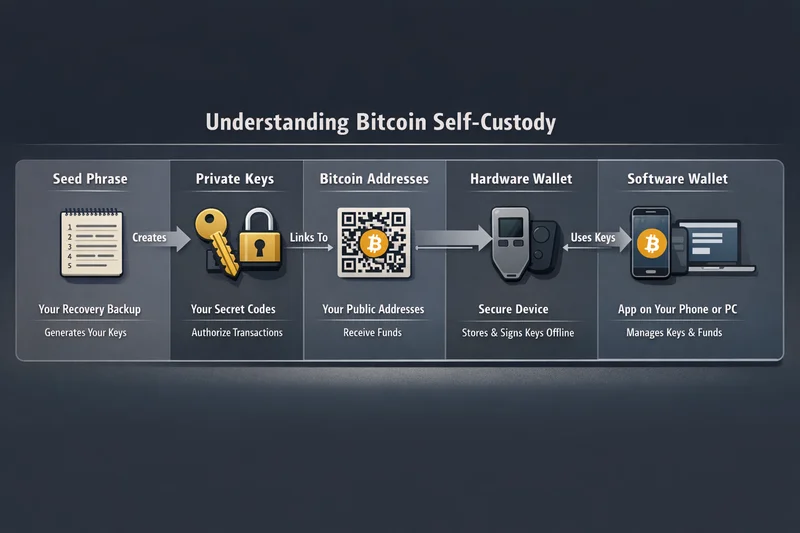
What finally made the system make sense wasn’t focusing on devices or apps, but on roles. Instead of thinking in terms of objects, I started thinking about what each part of the system actually does. Custodial services hold Bitcoin on your behalf. Wallets and devices are interfaces that allow you to interact with the network and sign transactions. The seed phrase isn’t money itself, but a recovery mechanism that proves ownership. And the Bitcoin network is the global ledger that ultimately records and enforces that ownership.
Once those roles are clear, self-custody stops feeling mysterious. All it really means is removing custodial services from the critical path. You’re not opting out of the network or rejecting tools. You’re just choosing to hold the one piece that can’t be replaced by customer support: the ability to regenerate access on your own terms.
Why the Hardware Isn’t the Asset
The process itself wasn’t perfectly smooth. There were unclear instructions, moments where the device didn’t behave the way I expected, and at least one small mistake that reinforced how permanent public information can be. But that friction turned out to be instructive rather than discouraging. Waiting until I understood everything would have meant never starting at all. Regenerative systems aren’t learned from manuals. They’re learned by doing, observing, correcting, and continuing. You don’t wait to understand every insect before planting a garden. You plant, watch what happens, and adapt.
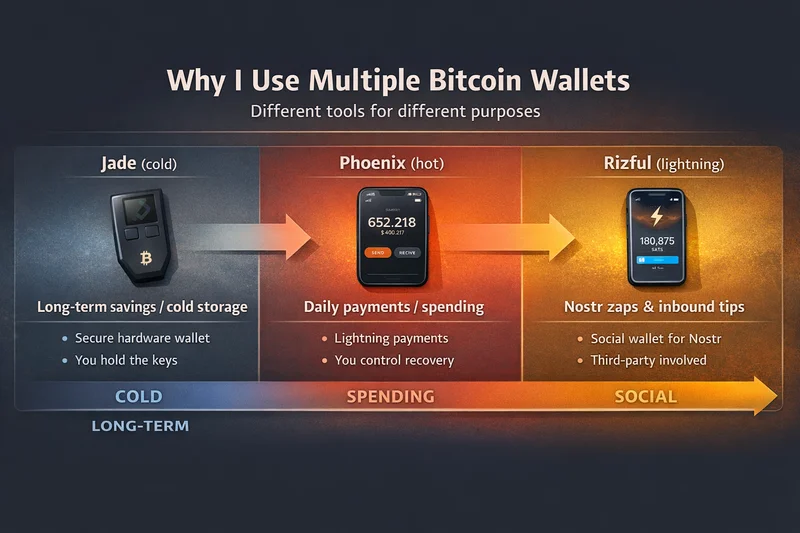
Self-custody felt the same way. It isn’t about being flawless or memorizing every technical detail. It’s about gradually reducing dependency and increasing clarity over time. You don’t need to abandon apps, banks, or services to do that. You just need to know what role they play, how to exit them, and how to recover independently if conditions change.
Final Thoughts
The most important shift for me wasn’t technical. It was psychological. Somewhere along the way, I stopped being a passive user of Bitcoin and became a steward of access. That mindset mirrors a lot of other systems in my life, from energy to data to land. If you can’t explain how something recovers from failure, you don’t really own it. You’re just renting stability from someone else.
This article isn’t meant to be a step-by-step guide. That kind of documentation exists elsewhere, and I’ve written a companion piece that focuses on the mechanics in more detail. What mattered first was understanding why self-custody exists, what it actually changes, and where responsibility moves when you adopt it. Once that clicks, the technical details stop feeling intimidating and start feeling navigable.
This isn’t about becoming an expert. It’s about closing the gap between participation and understanding. The tools are just tools. What matters is knowing which ones you can fall back on when the abstractions disappear.