
Why Bitcoin Makes Sense to Me

Why I Hold Bitcoin
Bitcoin makes sense to me for the same reasons I care about ownership, durability, and thinking long term. This isn’t a pitch, a prediction, or a get-rich plan. Writing it out helps me keep track of how my thinking evolves over time.
The Core Reason: A System with Rules That Don’t Bend Easily
At the center of my thinking is that Bitcoin combines three properties I don’t see bundled together anywhere else: decentralization, scarcity, and practical immutability. None of these guarantees success on its own. Together, they form a system whose behavior I can reason about over long periods of time.
Decentralization: No Single Gatekeeper
Bitcoin isn’t controlled by a bank, a company, or a government. There is no central authority that approves transactions, issues more supply on demand, or decides who gets access. That doesn’t mean there are no concentrations of power anywhere in the ecosystem—exchanges, miners, and service providers certainly exist—but the base layer rules don’t require trusting any of them.
Scarcity: Success Can’t Be Diluted
Bitcoin’s supply is capped at 21 million, with a transparent issuance schedule that trends toward zero. Roughly every four years, issuance is cut in half, and around the year 2140 the final block is expected to be mined. After that, no new coins will be created, and network security continues through transaction fees rather than issuance.
It’s important to be precise here. Scarcity does not guarantee value. Plenty of things are scarce and still worthless. What scarcity does guarantee is that if demand grows, that growth cannot be diluted by additional supply. If Bitcoin succeeds, it succeeds under fixed rules. If demand doesn’t grow, price won’t either.
Immutability: Changes Are Possible, but Not Casual
Bitcoin isn’t immutable in a magical sense. It’s immutable in a practical sense. Changing core rules requires a broad social and economic consensus across people running nodes, developers writing software, and participants choosing which version of the system they recognize. That coordination cost is extremely high.
Bitcoin has upgraded before, but those changes tend to be narrow and conservative. Altering monetary policy would be fundamentally different. Without wide agreement, you don’t get a “new Bitcoin,” you get a split—and history suggests the network converges on the chain that preserves continuity of rules, security, and trust. The friction involved is the feature.
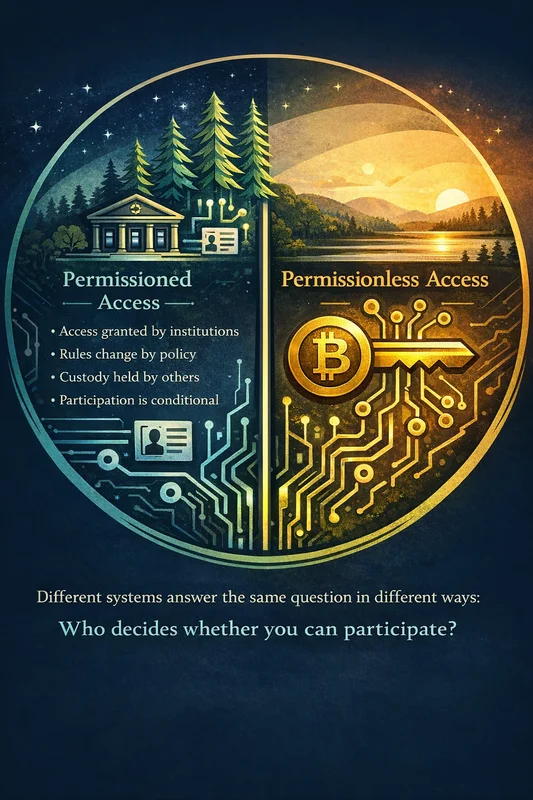
Self-Custody: I Hold Access, Not a Permission Slip
A major reason Bitcoin fits me is self-custody. When I hold and secure my own keys, I hold access. No intermediary can freeze my account, reverse transactions, or quietly change the terms of participation.
This comes with real responsibility. If I mishandle keys, there is no recovery process. That’s a genuine downside, and it’s not something I think everyone should do. I’m choosing it because I prefer systems where the risk is explicit, the rules are visible, and my access isn’t conditional on someone else’s discretion.
Why I Prefer This to Cash, Banks, Gold, or Stocks
I still think in comparisons, because this isn’t abstract philosophy. I’m attempting to store value over decades.
Cash is useful, but the dollars I earn today are intentionally designed to be worth less in the future. That isn’t a bug or a conspiracy; it’s policy. Inflation is meant to encourage spending and risk, and the side effect is that holding cash quietly loses purchasing power over time.
Savings accounts exist inside a banking and regulatory framework where access is conditional. Most of the time that works fine, and regulation does provide protections. But the principle matters to me: long-term resilience looks different when access depends on permissions and counterparties.
Gold has a place in a diversified plan, and I respect its history. But it’s difficult to store, verify, and move—especially across distance. I see real friction in relying on it as a modern, portable store of value.
Stocks can represent ownership in productive businesses, but much of the modern market feels dominated by financialization and extraction. That’s not a judgment on anyone who invests there; it’s me being honest about what I want to support and what I don’t.
Time Horizon: What I’m Actually Doing
I’m holding Bitcoin as a long-term store of value. I’m not planning to spend it unless it’s an emergency or it becomes part of retirement. If things go as planned, that may be 20 years out, when I’m around 70.
I accept volatility. It could last years or even decades. I see that volatility as the cost of holding a global, permissionless asset that is still being understood and adopted. I’m not betting on a straight line upward. I’m betting on fixed supply, decentralized control, and resistance to arbitrary rule changes.
If I’m Wrong, I’m Still Okay
This is where I keep myself honest. If I’m wrong about Bitcoin’s future, I lose an allocation—not my autonomy, not my identity, and not my ability to participate in the world. It’s meaningful to me, but it’s not existential. I’m not structuring my life around this being perfect.
Reflective Close
Bitcoin fits the way I’m trying to live: fewer hidden dependencies, fewer permission layers, and more ownership of the stack, from the soil under my feet to the systems I rely on. I don’t need certainty or universal agreement for this to make sense. I need to understand the tradeoffs clearly, accept them, and stay accountable to my future self.